Today, professional sports are built on strength and speed.
We can only speculate what the level of athleticism will be in professional sports in 5–10 years, when many young athletes who are now just starting their journeys will reach the professional stage.
However, one thing is already clear: by then, years of mastering and perfecting sports skills (dribbling, shooting, serving, spiking, smashing, etc.) will no longer guarantee a successful career.
Athletes will need much more than perfect sport-specific skills…
Changes in top-level sports, where ever faster and stronger athletes are in demand, are happening at the same time as test results of children’s and adolescents’ motor abilities and sports skills are declining.
Experts have concluded that participation in organized sports cannot compensate for the lack of daily movement, which is increasingly common among today’s young generations. Children now spend much of their time sitting at home, playing video games, and connecting through social networks—while in the past, they built those same social bonds through play on the playground.
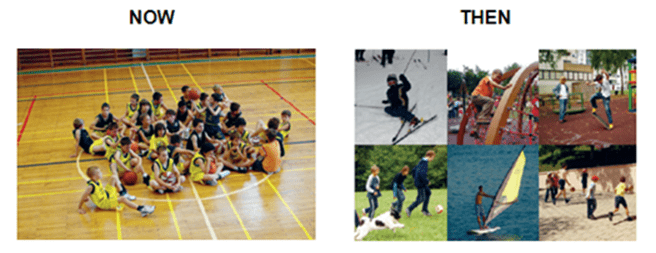
It was precisely this spontaneous play with peers—whenever and wherever possible—that enabled previous generations to develop so-called spontaneous motor skills, together with the underlying motor abilities.
However, such unstructured activities are becoming rarer in the daily lives of today’s children.
So, what can and must we do?
360° Youth Performance Pyramid
It is rare today for young athletes to practice more than one sport during the year, which means there is little or no transfer of skills from one sport to another.
Sport participation is beginning earlier and earlier, but it is often no longer playful or fun.
There is an early emphasis on technical and tactical knowledge, while very little training time is devoted to the targeted development of coordination, strength, or overall fitness. This shift occurs during the most critical developmental periods for building motor abilities and skills.
The logical consequence is that, at a certain point, due to underdeveloped coordination, speed, or strength, young athletes are unable to meet the demands of their sport. When selection criteria for higher-level performance are applied, many end up dropping out.
To prevent this scenario, youth sports training must be redesigned to prepare young bodies for the specific demands of their sport—through the systematic development of motor abilities and the acquisition of diverse movement skills.
That’s why we introduce the 360° Youth Performance Pyramid a scientifically grounded, age-appropriate roadmap for developing young athletes (ages 6–18).
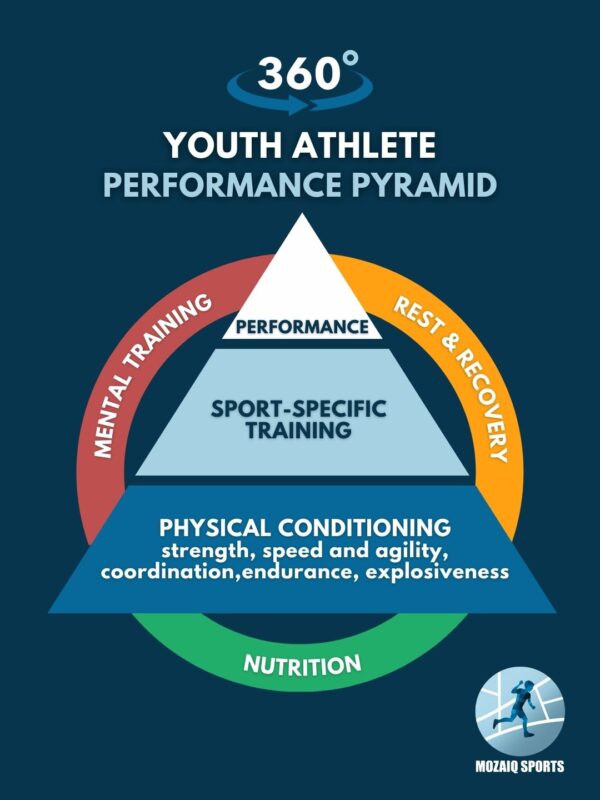
Peak: Performance
Progression: Sport-Specific Training
Foundation: Strength and Conditioning
Supporting pillars of Mental Training, Recovery and Nutrition ensure that athletes develop physically, mentally, and emotionally while minimizing injury risk.
This integrated model provides coaches with a clear, structured system to maximize athletic potential safely and effectively—preparing young athletes for long-term success in both sport and life.
Further Learning and Resources
To help coaches put the 360° Youth Performance Pyramid into practice, we’ve created two comprehensive learning tools:
Book Set – “Formula for Success in Sports”, which provides the scientific background and practical guidance for long-term athletic development.
Video Series – “Integral Physical Conditioning for Young Athletes”, designed to help coaches build the foundation and pillars of the 360° Pyramid step by step.
Together, these resources offer a clear path for developing young athletes safely, effectively, and sustainably.
Wishing you success,
Igor Macner