A common question among parents is:
"When is it safe for my child to start strength training or structured workouts?"
Many wonder about the right age to begin structured conditioning activities.
As more kids take part in sports, school fitness classes, and youth training centers, it’s important to have age-appropriate guidance on when and how to introduce structured physical development. This is especially true for training that improves movement quality, strength, coordination, and injury resistance.
What is Integral Physical Conditioning?
Integral Physical Conditioning is a structured, progressive approach to training that combines foundational movement skills with targeted exercises designed to improve athleticism and long-term physical development. It includes resistance, coordination, speed and agility, and explosiveness training — all tailored specifically for youth.
But more than a collection of exercises, it’s a teaching method. The goal is to help children move well, gain confidence, and develop athletic abilities in a safe and supportive environment, led by youth coaches and specialists who understand the unique needs of growing bodies and minds.
Why Starting Early Matters
We now understand that genes alone don't define a child's physical potential. Instead, there’s a powerful interaction between genetics and environment — especially during childhood.
In young children, strength and coordination improvements are less about muscle size and more about nervous system development. That means the earlier children are exposed to quality movement experiences, the more likely they are to build lasting athletic skills.
Preadolescence (typically between ages 7 and 10) appears to be a particularly important window. This is a time when kids' brains and bodies are highly adaptable — making it an ideal period to develop motor abilities and skills, meaning overall physical literacy.

Benefits of Starting Before Puberty
When integral training begins before puberty and continues through adolescence, children are better prepared to make the most of the physical changes that happen during growth spurts. They also develop stronger movement patterns and avoid many of the bad habits that often lead to injury later on.
Delaying this kind of training — or missing it entirely — may limit a child’s ability to reach their full potential. Once adolescence is well underway, the brain becomes less flexible for motor skill learning, and untrained patterns can be harder to correct.
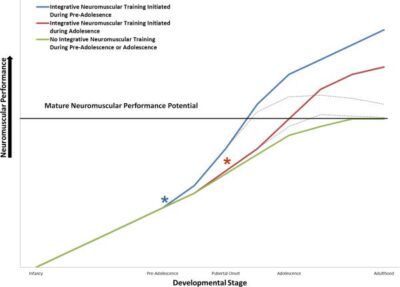
Figure: Conceptual model that compares the effects of integrative neuromuscular training initiated at different times in youth.
How to Know if Your Child is Ready
There’s no exact minimum age, but most kids around age 7 or 8 who are ready for organized sports are also ready for structured physical training — provided it’s developmentally appropriate.
They should be able to:
Follow instructions
Stay focused for short periods
Enjoy varied, playful movement
The key is not to push kids into adult-style training. Instead, use:
Bodyweight exercises
Games
Skill-based drills
Short bursts of activity with plenty of rest
Keep it fun, keep it safe, and focus on progress — not perfection.
Why Just Playing Sports Isn’t Enough
While sports offer many benefits, they don’t always provide the structured exposure needed to build key movement abilities and skills.
Children may play hard but still lack strength, coordination, or body control — especially if their sport practice is focused mostly on tactics or competition.
That’s where integral physical conditioning fits in.
It fills the gaps by deliberately developing the underlying athletic abilities that support both health and sports performance — like movement quality, postural control, and injury resilience.
Want to Learn More?
Integral Physical Conditioning — our practical approach based on the concept of Integrative Neuromuscular Training (NMT) — is a comprehensive, age-appropriate training method designed to support strength, skill, and injury prevention in youth athletes.
🎥 To help you apply these ideas, we’ve created a 4-part video series:
“Integral Physical Conditioning for Young Athletes”
You’ll get a close look at how to work with kids to improve:
Strength
Coordination
Speed and agility
Explosiveness
Whether you're a coach, parent, or trainer, this series is designed to help you build confident, capable, and injury-resistant young athletes.
Don’t miss our summer offer: 25% off!
Wishing you success,
Igor Macner
Reference:
Myer, G.D., Faigenbaum, A.D., Ford, K.R., Best, T.M., Bergeron, M.F., & Hewett, T.E. (2011). When to Initiate Integrative Neuromuscular Training to Reduce Sports-Related Injuries and Enhance Health in Youth? Current Sports Medicine Reports, 10(3), 155–166.
DOI: 10.1249/JSR.0b013e31821b1442